The Wingmen Playbook
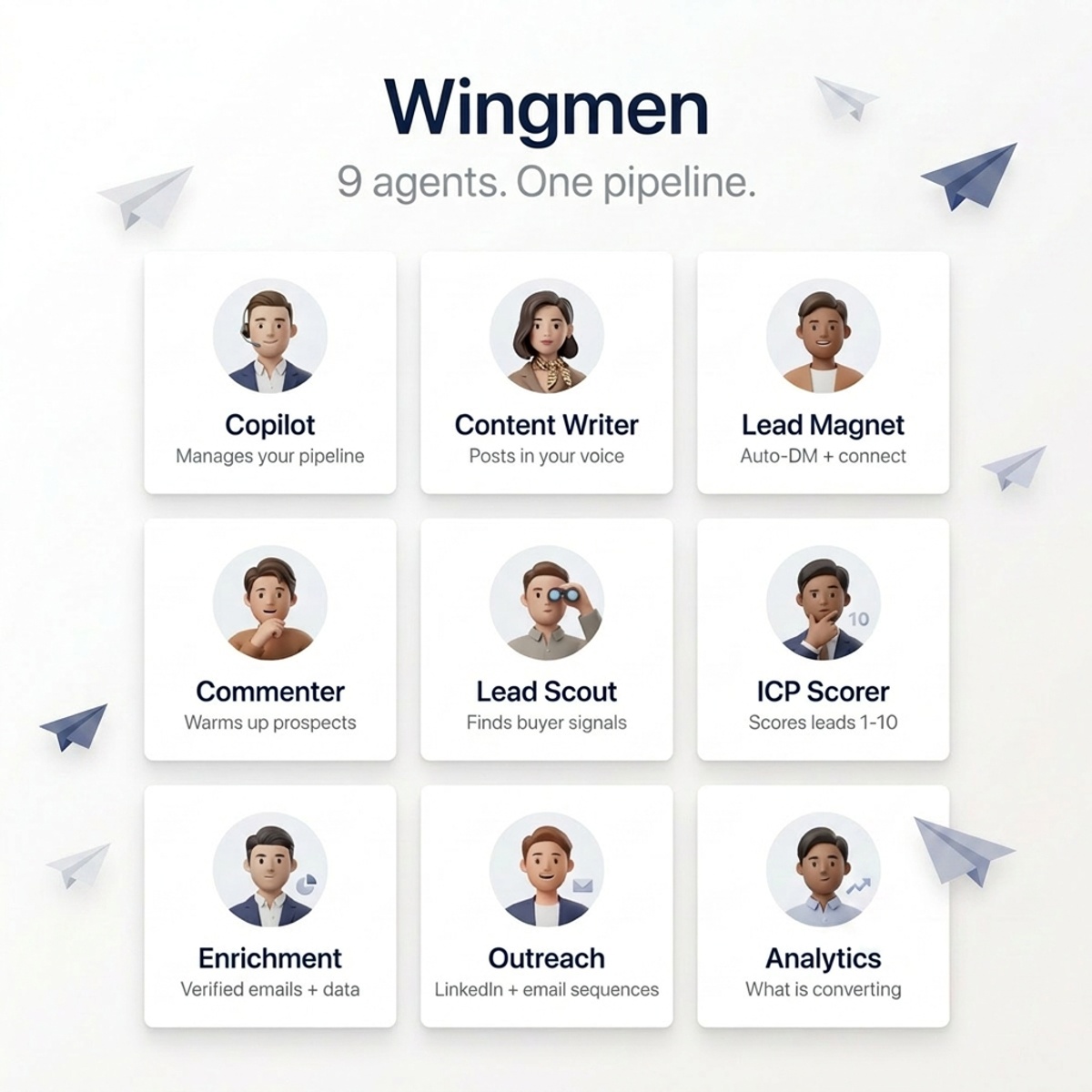
The 9-Agent Outbound System
The exact signals we track, the scoring prompt, the DM templates for each signal type, the follow-up sequence, and how we wire it all together. Use this manually or let the agents run it.
Why high-intent beats cold outreach
Cold outreach: 1-2% reply rate. You send 100 messages, get 1 meeting, and annoy 99 people.
Signal-based outreach: 15-30% reply rate. You message people who are already showing buying intent. They commented on a competitor's post. They're hiring SDRs. They just raised funding. They're actively discussing the problem you solve.
The difference is timing. You're not interrupting. You're joining a conversation they already started.
The 9 signals we track
Each signal type catches a different kind of buying intent. Here's what to look for and why it works.
Signal 1: Engagement bait commenters
Someone comments 'interested' or 'send it' on a post giving away a resource. They literally raised their hand saying 'I have this problem.' Highest intent signal.
Search query
"[your topic]" AND ("send" OR "dm" OR "comment" OR "inbox")First DM template
"Hey [Name], saw you commented on that [topic] post. We actually help companies with exactly that. Quick question - what's your biggest challenge with [topic] right now?"
Signal 2: Competitor audience
People engaging with your competitor's content already understand the problem space. They're solution-aware. Three searches per competitor: posts BY them, posts reviewing them, posts mentioning them.
Search query
[Competitor name], "[Competitor] review alternative", "[Competitor] comment send"First DM template
"Hey [Name], noticed you've been engaging with [competitor] content. Curious - are you using them currently or exploring options?"
Signal 3: Hiring signals
Company posting about hiring SDRs or sales roles = they need pipeline. They're spending $60-80K on a hire that takes 3 months to ramp. That's your opening.
Search query
hiring "SDR" AND ("looking" OR "join" OR "team")First DM template
"Hey [Name], saw you're building out the sales team. Quick question - are you looking to ramp outbound while the new hire gets up to speed?"
Signal 4: Job changes
New VP Sales, new Head of Growth, new CRO - they have fresh budget and need to prove themselves in the first 90 days. They're actively looking for wins.
Search query
Apollo API: recent role changes, last 90 days, target titlesFirst DM template
"Hey [Name], congrats on the new role at [Company]. Always curious what's top of mind in the first 90 days - is pipeline one of them?"
Signal 5: Funding signals
Just raised Seed/A/B. They have money and pressure to grow. Outbound is usually one of the first things they invest in.
Search query
Apollo API: recently funded companies, Seed/Series A/BFirst DM template
"Hey [Name], congrats on the raise. We work with a lot of post-funding teams to get outbound running fast. Is that on your radar?"
Signal 6: Your post engagers
People who comment on YOUR content already know you. Warmest leads possible. They engaged, you follow up.
Search query
Scrape commenters from your own LinkedIn postsFirst DM template
"Hey [Name], appreciate the comment on my post. Curious what you're working on - sounds like we're in a similar space."
Signal 7: Pain point discussions
Someone posting about a problem you solve. They're venting, asking for advice, or sharing frustrations. That's your cue.
Search query
"struggling with [problem]", "[problem] is killing us", "anyone else dealing with [problem]"First DM template
"Hey [Name], saw your post about [problem]. We've been working on exactly that - mind if I share what we've seen work?"
Signal 8: ICP title matches
Active LinkedIn posters who match your ICP titles. They're visible, engaged, and reachable. Not a strong signal alone but good volume.
Search query
Search for posts by people with titles: Founder, CEO, VP Sales, Head of GrowthFirst DM template
"Hey [Name], been following your posts on [topic]. We help [type of company] with [value prop]. Worth a quick chat?"
Signal 9: Lookalike leads
People similar to your best-converting leads. If Founders at 20-person SaaS companies in the UK convert well, find more of them.
Search query
Apollo API: titles + company size + location matching best customersFirst DM template
"Hey [Name], we work with a lot of [similar companies] and thought you might find this relevant. Quick question - how are you handling [topic] right now?"
The scoring prompt
Not every lead is worth reaching out to. We score every lead 1-10 using AI before anyone touches them. Here's the exact prompt logic:
ICP scoring prompt
Score this lead 1-10 against the ICP.

8-10: Strong match. Right role, right company type, right region.
5-7: Decent match. Some overlap but not perfect.
3-4: Weak. Wrong role or company type.
1-2: Competitor, wrong region, or irrelevant.

CRITICAL:
- If they SELL the same thing as us (outbound, lead gen, cold email) → score 1 (competitor)
- If excluded region (no budget market) → score 1
- Check headline for location clues, language, company type

Return: {"score": N, "reason": "one sentence explaining why"}
Auto-triage rules
Score 8-10: Auto-approved. Moves to contacts list. Agent picks them up.
Score 4-7: Pending review. You decide.
Score 1-3: Auto-removed. Kept in database but not contacted.
The outreach sequence
Every message is generated contextually per lead. No templates. The AI uses their headline, signal type, company, and score reason to write something specific. Here's the sequence:
Connection request
Short note referencing why you're connecting. Under 280 chars. Mention something specific about them.
AI prompt
Write a LinkedIn connection note (max 280 chars). Reference something specific about them. No pitch. Just a human reason to connect.
First DM (after they accept)
Acknowledge the connection. Reference their background. Plant a seed of value. End with a soft question. No pitch.
AI prompt
Write a short DM (max 300 chars). Reference their background, mention something relevant. No hard pitch. End with a soft question.
Profile visit
Visit their profile. They see you in notifications. Keeps you visible without being pushy.
Follow-up
Different angle. Add new value. Not 'just following up' - give them a reason to respond.
AI prompt
Write a follow-up (max 250 chars). Add new value or a different angle. Not pushy. Not "just following up."
Email (if enriched)
Same person, different channel. Reference the LinkedIn connection. One clear CTA.
AI prompt
Write a cold email (subject + body, max 150 words). Reference the LinkedIn connection. One clear CTA.
When they reply
Most systems stop at "they replied, now it's on you." We handle the conversation based on what the objective is.
Interested
Share your calendar link. Be specific: 'Got a 15-min slot Thursday afternoon - want me to send an invite?' Don't send a generic booking page with no context.
Objection
Address it in one sentence. Don't argue. Reframe with a specific outcome. Then circle back: 'Fair point. Curious though - how are you handling [specific thing] right now?'
Not interested
Thank them. Close gracefully. 'Appreciate the honesty. If anything changes, I'm around.' Never push. They might come back later.
Out of office
Note it. Follow up when they're back. Don't auto-reply to an OOO.
Key rule: Never reply instantly. Wait 3-8 minutes. Instant replies look automated. A 5-minute delay looks like a busy person who saw the notification and responded when they had a moment.
The warming layer most people skip
Before you ever DM someone, they should already recognize your name. Two things make this happen:
Content
Post 3-5x per week in your voice. Not generic LinkedIn advice. Your actual takes, your actual experiences, your actual results. When a prospect sees your DM and clicks your profile, they should see someone who clearly knows what they're talking about.
The engagement bait play: End posts with "Comment [KEYWORD] and I'll send you [resource]." Every commenter becomes a warm lead with a built-in reason to DM them.
Background engagement
Before reaching out to a prospect, visit their profile (they see you in notifications) and leave a genuine comment on their post. Not "great post!" - an actual thought that adds to the conversation.
The compound effect: After a week of this, when your DM arrives, they think "oh I've seen this person around" instead of "who is this random person messaging me?"
How fast this gets running
10 min
ICP + signals configured
AI analyzes your website and sets up your ICP, scoring rules, and signal sources.
1 hour
First leads scored
Pipeline runs across all 9 signal types. Leads scored and ready for review.
Day 1
Outreach live
Contextual messages going out. Content scheduled. Prospects getting warmed.
You can do all of this manually.
Search LinkedIn, scrape commenters, score leads in a spreadsheet, write each DM, manage follow-ups in your head, post content, comment on prospects' posts, track what's converting. It works. It takes about 4-5 hours a day.
Or you let 9 agents do the 9 jobs.
Same signals. Same prompts. Same sequences. Running on autopilot while you focus on closing.

I was that founder. Running outbound for my own startups, doing $100K/month - not because I had a great system, but because I was the system. Every lead, every message, every follow-up ran through me.
Then I ran an agency and saw every founder stuck in the same loop.
So I built what I needed: an AI team that does all 9 jobs. I just review the results.
- Nemanja
See it running with your ICP. 15 minutes. Live demo.
Book a callP.S. Everything in this playbook works manually. But you're already spending hours on outbound every week. The only question is whether it's you doing the 9 jobs, or the agents.